
Plantronics CS50-USB Headset
Earlier this year, Plantronics introduced the CS50-USB, a wireless headset specifically intended to work with software-based VoIP phones such as Skype.
The CS50-USB combines several pieces of technology into its overall solution, including a base station that plugs into a USB port on the host computer, a small over-the-ear headset that communicates with the base station via 900Mhz radio, and a software component that integrates the hardware with the user's preexisting software-based phone.
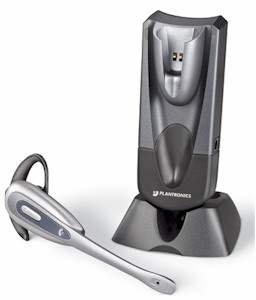
The base station is the heart of the package, and appears to the host system as a regular USB sound card with its own volume controls. When the base station is connected to a powered USB port, it will draw power from that connection to charge the headset, but a separate transformer is also supplied that can be used if you don't have any powered USB ports available.
The wireless headset component is small and lightweight, and looks like many of the over-the-ear headsets commonly sold for cellular phones. The ear piece snuggles into position without pinching, while the microphone hangs beside the cheek, away from hot coffee and snacks. The headset is remarkably light and holds up well to extended wear, but a traditional headband is also provided which can be used instead of the ear-loop if preferred.
There are a couple of buttons for turning the radio on and off and adjusting the volume, and a status indicator to let people know that you're on the phone and not just mumbling to yourself, but most of the call-management functions are expected to be handled by the soft-phone running on the PC, with the headset being spartanly designed with that usage in mind.
The software component is called PerSonoCall, and runs in the Windows system tray (2000 and XP only) to show the current radio status. A tabbed dialog-box provides information about any calls that may be active, the state of the mute button, and other extended information. PerSonoCall is able to integrate itself into a handful of soft-phone packages, so that you can answer and disconnect calls just by activating the headset radio, without having to touch the software phone itself.
The Test and Verdict
In my testing, I found the device to be extremely useful for its intended purpose, although it's important to recognize that the CS50-USB is specifically intended for use as an accessory to an existing soft-phone solution, rather than the other way around. For example, there's no easy way to "dial out" with the device since there's no keypad interface, so you have to rely on the soft-phone for outbound call management.
Similarly, even though the CS50-USB shows up as a regular Windows audio device, it is limited to monaural audio in just one ear. And since it supports only the audio spectrum needed by traditional telephony, it isn't really suitable as a full-time replacement for desktop audio systems. Once you come to the accept its purpose, however, the device proves to be extraordinarily useful.
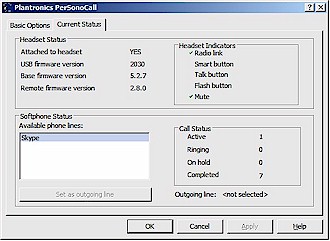
For my testing, I hooked the base station to a powered USB port on my Dell D/Dock laptop docking station, and told the software installation package to use Skype, which it located and extended appropriately. Once this was done, I was able to answer incoming Skype calls by simply activating the headset radio, and could disconnect calls by turning off the headset's radio just as easily.
Similarly, I could use Skype to answer the call directly, and the PerSonoCall software would automatically activate the headset radio on my behalf. However, hanging up the call from inside Skype did not cause the radio to automatically disconnect, and I had to manually turn off the radio in order to keep the battery from getting drained. I'm pretty sure this is just an oversight, since all of the other functions work as expected.
I was also able to use the headset with soft-phone applications that aren't directly supported, but you have to remember to turn the wireless link on and off manually with the headset button. One related annoyance here is that you have to hold down the headset button for four full seconds in order to turn off the radio link. This is designed to avoid accidentally dropping a call, but it's much longer than needed.
I had no problems with the range of the wireless signal, and there was no noticeable interference from other wireless phones and devices.
The biggest concern is the price tag: the CS50-USB has a whopping $299 suggested retail price, but can be found for a little over half that. Still, this is a lot of money for someone using software-based telephony in order to avoid phone charges.
On the other hand, the price is perfectly reasonable for businesses using voice-over-IP applications for the productivity gains. Having a wireless headset means being able to process calls even while you're looking through filing cabinets or getting a coffee refill, and the improved productivity alone may be enough to offset the cost.
In the end, the CS50-USB is an excellent add-on device for those who can get by with soft-phone telephony, and can afford to buy it (or can get somebody else to pay for it). It's one of the more innovative products around, and is very good at what it does.

Copyright © 2010-2017 Eric A. Hall.
Portions copyright © 2005 Tom's Guide Publishing. Used with permission.