
iSCSI: Storage Networking sans the SAN?
Storage Area Networks (SANs) have proven to be a promising technology, simplifying the management of large and complex storage systems. But they come at a high cost: First-generation SANs depend on Fibre Channel (FC) networks, which require laying new cables, learning new skills, and buying specialized switches. Unfortunately, this has made SANs hard to justify for all but the largest installations.
Internet SCSI (iSCSI) could change all of that. Because iSCSI runs over standard TCP/IP links, it's easier to build, manage, and justify than FC, making SAN technology more affordable and accessible for everyone. A small iSCSI SAN can be built on top of an existing network infrastructure and even use ordinary Windows or Linux servers as remote storage arrays. Larger networks can also benefit since iSCSI turns the SAN into a low-cost commodity.
If you already use FC, there's probably no reason to move to iSCSI yet. But if you're about to build a new SAN, iSCSI is a strong contender. Even if you've hitherto ignored or rejected SAN technology, iSCSI's low cost means it may be time to reconsider.
Remote RAID
The principle behind a SAN is simple: Transport storage commands and data over long distances so that a host can connect to a remote storage device as easily as it connects to internal drives. With iSCSI and FC alike, this is handled by a local storage interface that communicates with storage devices across a network of some kind, with local commands and data being relayed into and out of the network as needed. The host computer is still responsible for managing the logical drives that have been exposed to it, but those drives are usually somewhere else, not inside the host's cabinet.
At first glance, this architecture doesn't appear compelling. Compared to a local drive, a storage device located on the other side of a network introduces additional latency and overhead. But a SAN can also offer powerful benefits, the most important of which is simplified management. Instead of dealing with local drives on each server, you can consolidate storage into a single massive RAID unit that presents logical drives to each system on the network. Backup is also simplified, allowing disk-to-disk backups and block-level replication between storage devices.
None of these features are unique to iSCSI. However, iSCSI does provide the ability to run a SAN over TCP/IP, which can scale to longer distances than rival SAN technologies. And whereas FC networks have very specific requirements, iSCSI is more flexible. TCP/IP can run over any physical medium, so it offers a choice of topologies. For example, since iSCSI uses IP, it can use standard Ethernet switches and routers, which cost less than their FC counterparts, and IP packets can travel across alternative LAN topologies just as easily. It can also be easier to manage because it's based on familiar standards and doesn't involve learning as many new skills.
IP Channel
From the network's perspective, iSCSI is just another service that runs over TCP/IP. It can use the same networking stack as other applications, with clients requesting data from servers. The main difference is that its function is more specialized. Whereas other layer-7 protocols such as SMTP are agnostic toward the technologies used at their endpoints, iSCSI is designed as a way to extend an existing storage technology across IP networks.
The iSCSI drafts and RFCs are published by the IETF, but based on the SCSI specifications from the ISO's Technical Committee Ten (T10), the ANSI-accredited body responsible for developing and maintaining the core SCSI standard. To the committee, iSCSI is just another SCSI transport and just as officially sanctioned (though technically it's a superset of SCSI, providing additional functionality through unique commands and data formats used for secondary services such as authentication). iSCSI can be used in exactly the same way as FC, InfiniBand, or local SCSI cables.
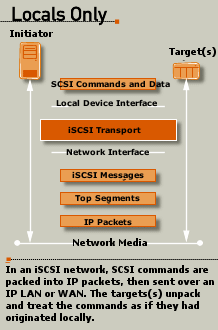
For iSCSI purposes, the SCSI protocol is conceptually similar to TCP/IP's client/server architecture. Every SCSI link involves a host adapter, called a SCSI initiator, and a storage device, called a SCSI target. A local SCSI bus usually connects a single initiator to up to seven targets, but a SAN allows an unlimited number of each. In iSCSI, the initiator acts as a client, and the target a server (see figure). The initiator's iSCSI stack packs SCSI commands and data into IP packets, which are then unpacked by the target for processing as if they had originated locally.
Virtualized Storage, Virtual Network
iSCSI's most obvious benefit is that it can create a virtual SAN using existing network infrastructure. However, this benefit is easily overstated. If a network already has gigabit switches in place with bandwidth to spare, the benefits of iSCSI are immediate. But most networks aren't usually this overprovisioned, and since SCSI involves transporting large amounts of data very quickly, you'll likely need to spend big bucks on upgrades to deal with the additional traffic.
Infrastructure reuse is still important, however. Upgrading an existing network is less expensive than building a new one from scratch, making SANs cost-effective for small networks that can't justify FC's high price tag. The resultant mass market will push down iSCSI costs further, to the point where it replaces FC as the dominant SAN technology. Server vendors will likely jump on the iSCSI bandwagon just as they did with FC, offering 1U and blade servers with integrated iSCSI ports.
A lightly burdened departmental server may be able to use a single 100-Mbit/sec Ethernet link for both storage and application traffic, but a busy database server might easily require a dedicated Gigabit Ethernet connection for storage traffic alone. If there are many such servers, the cost of iSCSI can approach that of FC, though IP and Ethernet do have the advantage that they can be reused in future projects if the SAN is abandoned. The costs are even higher when storage traffic is sent over a WAN. However, iSCSI still scores over alternatives here. FC depends on dedicated cabling and therefore can't run over a public network at all. Its range limit is about 10km using single-mode fiber.
FC can be made to cover longer distances, but only by using FC over IP (FCIP), a technology that's much like iSCSI and even uses some of the same Internet drafts (see "State of the Standards"). The difference is that whereas iSCSI takes raw SCSI and packs it into IP packets, FCIP requires that the SCSI data first be packed into Fibre Channel Protocol (FCP) frames. This adds additional processing and bandwidth overhead, so FCIP compares poorly to iSCSI as a standalone means of transferring storage through IP. Its main use is in interconnecting existing FC networks without installing new FC hardware.
Traffic Trap
Infrastructure reuse also depends on the types of nonstorage applications running over the network. iSCSI uses TCP for its reliability and flow-control services, which are highly sensitive to packet loss and delay. For example, congestion that results in a packet loss of only 2 to 3 percent is sometimes enough to cause TCP sessions to drop to very low utilization rates. This means that much of the network's bandwidth is wasted because of the way TCP tries to fill the available capacity.
If there's any packet loss or delay, TCP blames congestion and cuts the data rate in half before gradually ramping back up again. As a result, a minor amount of periodic congestion can cause the data rate to halve several times in a row. If the existing network is used for multimedia or other applications that cause traffic spikes, storage may be better off on a physically separate network.
There are other reasons to build a dedicated SAN, particularly for large installations. Networks that increase throughput with Jumbo Frames (which allow up to 9,000 bytes of data per Ethernet frame, instead of the traditional 1,500 bytes) will likely want to restrict these to hosts capable of using them. This avoids performance penalties associated with fallback algorithms. Security is also enhanced by physical separation, especially if many different departments or groups have access to the network.
Infrastructure reuse is often more theoretical than practical, but even networks that do need to invest in additional infrastructure can benefit from the lower costs of TCP/IP and Ethernet. Because they're familiar and use existing skills, most network managers will also find them easier to manage than FC.
Services as Software
iSCSI's advantages over alternative SAN technologies aren't limited to the network infrastructure. Because every server already has a network connection and a TCP/IP stack, iSCSI can use a software-based SCSI initiator. With FC, servers require a dedicated SCSI adapter, which is more expensive than an off-the-shelf Ethernet NIC.
Reusing a server's network connection isn't always feasible, however. Software initiators can place a high load on a server's own processor and other system resources, so they're most suitable for lightly burdened departmental servers.
A data center server that's already working full time will need to off-load storage processing to dedicated iSCSI hardware. Software initiators are likely to be useful in a small SAN that shares Ethernet cables with other IP packets, but not in a larger one with its own dedicated infrastructure.
An iSCSI host interface must provide several services. At the top of the stack is a SCSI driver. The driver or a subordinate protocol engine encapsulates raw SCSI commands and data into iSCSI messages, maps the local drive assignment to remote devices, and is responsible for related tasks such as authentication. Further down, iSCSI messages must be transferred over TCP/IP sessions, which may involve services such as error detection and encryption. At the bottom, the host interface must manage low-level network media functions.
Except for the Physical-layer requirements, any of these service sets can be provided in either hardware or software. Each additional software service requires incrementally greater amounts of processor overhead. Conversely, hardware services result in lower CPU overhead, but are less flexible and prevent the network interface from being reused for nonstorage purposes.
Web Hosting
At one extreme, Microsoft provides a software-based iSCSI driver for Windows 2000 and derivative systems. SourceForge.net also hosts a project that's actively involved in developing an iSCSI driver and initiator for Linux. Both of these drivers are capable of accessing remote iSCSI devices through the OS's own TCP/IP stack, but impose significant processor overhead. They're most useful for high-horsepower servers not already burdened with significant processing demands.
A step up from the software-only approach, "smart" network adapters can take on some common network processing tasks. These are designed to help any server busy with TCP/IP processing, so they don't perform any iSCSI-specific functions. For example, Alacritech's 100Mbit/sec and Gigabit Ethernet adapters can perform TCP fast-path computations on the NIC itself, lightening the load on the host CPU.
Hard Hosts
At the other extreme, dedicated iSCSI adapters from Adaptec, Intel, or QLogic can provide all necessary TCP/IP and SCSI functions in hardware, with only a minimalist driver needed in software. To the OS, hardware initiators are indistinguishable from FC or local SCSI adapters. For example, Adaptec's 7211 card is effectively a traditional SCSI host adapter, but one that accesses networked devices through TCP/IP instead of providing an internal storage bus.
The biggest caveat with hardware initiators is that they typically operate independently of the host OS. The host's TCP/IP stack can't be bound to the network adapter, making it difficult or impossible to use with other network applications and services. The adapter's internal TCP/IP stack doesn't usually support extended features such as RIP, OSPF, or other dynamic routing protocols. Similarly, it might support static DNS, but not Lightweight Directory Access Protocol (LDAP). Finally, network adapters are often unable to support failover and load-balancing protocols provided in the host OS.
One advantage of dedicated hardware is that it enables booting from a SAN-connected drive, something not possible using a software initiator that requires an OS to be loaded before it can connect. This gives it the potential for use in diskless workstations, not just in servers, thus simplifying desktop management.
Soft Targets
iSCSI also entails changes for SCSI targets. Major storage vendors such as EMC and Network Appliance are already pushing iSCSI versions of their existing storage products, letting FC customers stick with familiar suppliers when moving over to iSCSI.
As an alternative, a new breed of vendors are offering software-based targets that run on off-the-shelf computing platforms. These are currently aimed at the low end of the market, with low prices to match. For example, String Bean Software is beta-testing a software target that will allow Windows 2000 and 2003 servers to share their locally attached storage over iSCSI. Ardis Technologies offers a similar product for Linux, though this requires a modified kernel. Other vendors have taken Ardis' approach a step further, selling iSCSI appliances that consist of several hard drives in a customized Linux PC.
Software targets can't yet compete with high-end storage products, but they may be adequate for a departmental or small-office SAN in which a dedicated appliance can't be justified. The combination of multigigahertz processors, network accelerator cards, RAID-aware OSs, and warm-swappable drives allows software targets to deliver decent functionality at a low cost. While a RAID cabinet can run up to six or seven figures, these no-frills offerings have the potential to reach megabytes-per-penny.
In the short term, this kind of product won't significantly impact high-end offerings; it's useful only where advanced software and support isn't necessary. Over time, however, both Moore's Law and maturing products should allow software targets to compete head-to-head with Cadillac-class systems. The breakout will occur within two to four years, when Microsoft or one of the mainstream Linux distributors includes iSCSI target functionality in a server OS.
Though currently curiosities for the adventurous, software targets represent the future of the SAN. Even without them, iSCSI will ultimately result in accelerated commoditization, lower costs, and wider SAN adoption.

Copyright © 2010-2017 Eric A. Hall.
Portions copyright © 2004 CMP Media, Inc. Used with permission.