
Lucent 802.11 WaveLAN Adapter
Now that vendors are backing the IEEE 802.11 specification with shipping products, wireless networking is finally coming of age. Network managers have a choice of several 802.11-compliant products that should work with one another, allowing you to build up a multivendor wireless network easily.
Leading the pack is Lucent, which recently introduced its WaveLAN line of 802.11-compliant wireless products: a WaveLAN IEEE 802.11 PC Card, WaveLAN ISA adapter, and WavePoint II Access Point 802.11-to-Ethernet bridge. Each of these devices is capable of sending traffic at speeds as fast as 2Mbps — at distances as far as 1,200 feet in unobstructed environments. They can even fall back to speeds of 1Mbps at distances as far as 1,400 feet or in environments that are heavily obstructed.
Other standout features of the WaveLAN devices include echo-cancellation technologies, which provide clear signaling in cavernous facilities where radio signals are bounced around for extended periods, and an RTS/CTS negotiation protocol for nodes that can't see traffic from other nodes.
Shared architecture
What's most intriguing about Lucent's WaveLAN offerings is how they all share the same fundamental component: a Type II PC Card. Even the ISA adapter uses the WaveLAN PC Card by way of an external Type II slot design, with the PC Card simply inserting into the rear of the ISA card's slot. The 802.11-to-Ethernet bridge also uses the PC Card design, providing two Type II slots for plugging in the WaveLAN PC Cards.
The PC Card itself is well-designed. The entire WaveLAN product is integrated into the card—including the antenna. When the card is fully inserted into a Type II slot, about 1 inch of the adapter (the antenna portion of the card) is exposed.
If additional signaling power is required, an external antenna can be inserted into an aperture on the card, providing a boost in range and signal strength. This antenna works across the WaveLAN line.
For the ISA and PC Card users, drivers are provided for DOS, Windows 95, and Windows NT. Older WaveLAN products have drivers for Macintosh, OS/2, and Linux users; these platforms will be supported by the newer WaveLAN models in the future.
Successful connectivity
I set up the various components on my office network and tested their connectivity and performance in a variety of environments. Even though my office is in an older home with thick plaster walls, the products maintained an exceptional level of signal strength and performance, always staying at the 2Mbps rate.
For my Windows 95 laptop, I installed the adapter along with the provided networking drivers and Microsoft's TCP/IP stack and networking client. I was able to assign a Dynamic Host Configuration Protocol address, log in to the local NT server, retrieve my profile, and edit network-based documents without any difficulty.
In simple performance tests, I was able to download files from a local FTP server at speeds of 1.2Mbps. Although this is a little less than Lucent's stated maximum of 1.4Mbps, some of the performance loss can be attributed to the Windows NT-based FTP Server, which exhibited throughput problems on all of the clients (including the ones on the 100Base-T LAN).
Regardless, the performance was more than adequate for loading Web applications and for editing server-based documents. Although I wouldn't recommend that users try to load shared copies of Microsoft Word using this architecture, it's suitable for general document sharing and Web browsing.
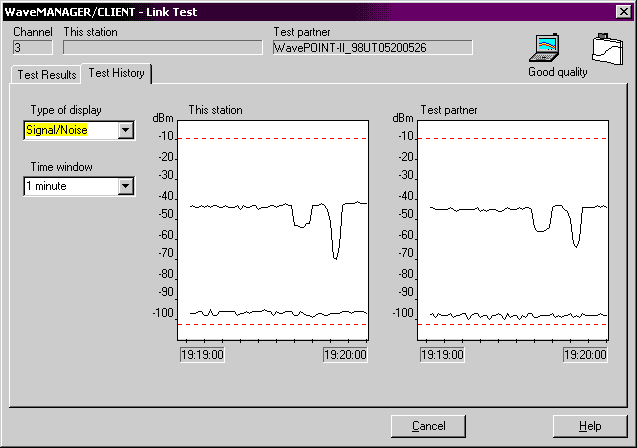
I also found Lucent's bundled management software easy to use, allowing me to view the current and historical signaling strength for my network. I was able to carry the laptop around the office while the signal was actively measured to find (and avoid) areas where obstructions would prevent me from connecting at optimum speeds.
Overall, the WaveLAN products are easy to use and don't impede wireless access. Although they don't offer the throughput of a wired connection or of proprietary wireless solutions such as RadioLAN's, the WaveLAN line does offer flexible wireless networking at speeds that are adequate for everyday use—without bulky antennae.
For mobile users who need distance, easy mobility, and standards-based wireless networking, the WaveLAN line is ideal: It offers good performance and features to free you from most physical limitations.

Copyright © 2010-2017 Eric A. Hall.
Portions copyright © 1998 InfoWorld Media Group, Inc. Used with permission.