
Cat@log v2.5
Internet-commerce solutions run the gamut from low-end, fill-in-the-blank services like Viaweb, to fully-customized sites written from scratch using C and Perl.
Somewhere in between these two extremes is The Vision Factory's Cat@log 2.5, a code-free (yet powerful) platform for building, deploying, and managing I-commerce Web sites.
At heart, Cat@log is a database-centric rapid application development (RAD) platform that just happens to include really strong commerce technology. You build a storefront, shopping basket and transaction services by tapping into your existing product and customer databases, wrapping the tables and fields with commerce objects and controls, and then fine-tuning the presentation with stock HTML commands.
Once stitched together, you simply publish the project to a Web server as a collection of CGI scripts, and voila—you've got a Web-based commerce system that's integrated with your existing data.
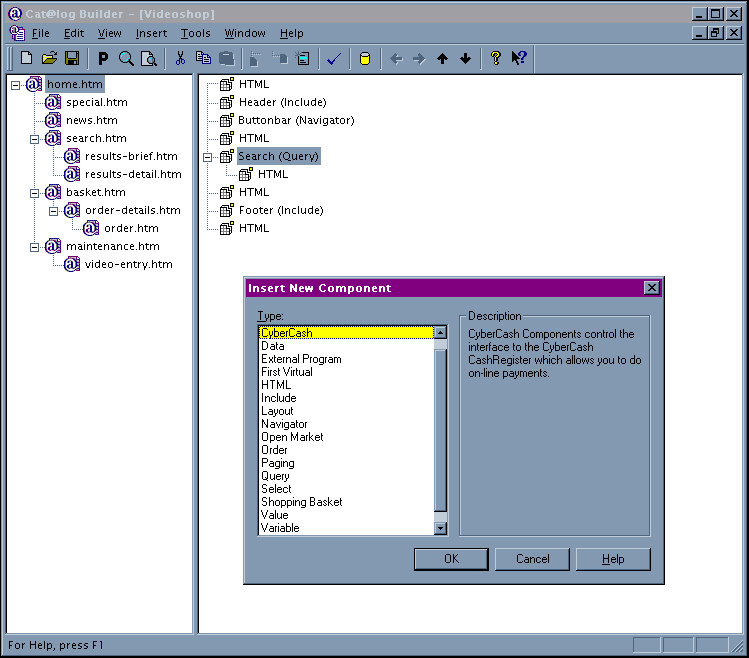
What you can't do is write custom code. Unlike high-end development environments, such as Oracle Applications and Allaire's Cold Fusion, Cat@log doesn't provide any scripting or coding interfaces whatsoever. There are no services for writing an IF statement. However, all of the common tasks are easily available and thoroughly configurable through the extensive dialog boxes and menu options provided by the object controls.
Cat@log 2.5 consists of two separate services: a client-side development system where Web pages get created, and a server-based CGI gateway for executing the resulting applications.
The client component, Cat@log Builder, is where you'll spend 99 percent of your time. Most of the work involves adding objects that provide a service (such as display data, or add-to-basket) and then tying these objects to back-end databases.
The list of services provided by Cat@log's objects range from database-specific functions such as queries and updates, to commerce services such as calling an external payment service. There are also components for adding blocks of HTML code, managing user cookies, and tracking variables.
Each of the objects is integrated with some sort of database. Cat@log supports all ODBC drivers and native drivers for Oracle, Sybase, Informix, and SQL Server. Almost every function is mapped to a database field.
For example, a common setup would include a database containing records for each item that you sell, with fields for item description, part number, price, and so forth. You would display this information by inserting a data lookup object into the project, and then creating a query object that displayed this information. You could then add HTML formatting or create additional objects to do things like offer special discounts to specific customers.
The intuitive, Wizard-based design of Cat@log Builder makes it easy to get a storefront operation up and running extraordinarily fast, using your existing legacy databases.
Once you have the project defined, you save it to a local or remote Web server with just a couple of mouse clicks. Cat@log Builder installs Cat@log Manager, the back-end component necessary for the specific target system. Cat@log Manager can run either as a general purpose CGI gateway, or for much faster performance, through Netscape Server API and Internet Server API plug-ins.
Cat@log 2.5 also adds the capability to perform statistical gathering and monitoring, either on a project-wide basis, or for specific fields.
Two other important new features in Cat@log 2.5 are integrated sales-tax and shipping-calculation widgets. You can incorporate these services on a global level at check-out time, or you can integrate them with individual inventory items.
Cat@log 2.5 also includes a variety of integrated payment objects. Among those directly supported are CyberCash, First Virtual, Open Market, and VeriFone. Cat@log also provides a generic "external" object that can be used to reference an external application, allowing Cat@log Manager to call another billing service, e-mail client, a faxing program, or any other program.
It is this wide array of native objects that makes Cat@log as powerful as it is. Even without the ability to write specific code, The Vision Factory's designers have thought of just about everything you need in order to build a comprehensive commerce site.
Multimillion dollar commerce sites will likely want a development platform that supports the use of custom coding. But mid-size companies that need to build a Web-based front-end to an existing order-processing system—and to the underlying database in particular—will benefit tremendously from Cat@log's flexible and easy-to-use architecture.
Cat@log uses functional components and a database-centric metaphor to provide a rapid Web-commerce development platform for existing legacy data.

Copyright © 2010-2017 Eric A. Hall.
Portions copyright © 1998 InfoWorld Media Group, Inc. Used with permission.