
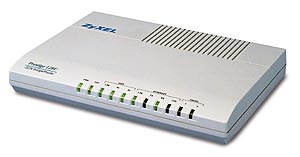
ZyXEL Prestige 128 ISDN Bridge/Router
In the continuous search for improved small office/home office (SOHO) connectivity, we frequently have to make trade-offs among ISDN routers, terminal adapters and analog device support. Not any more.
ZyXEL, a company well-known for its analog fax and modem technology, has developed the Prestige 128 ISDN Bridge/Router, an exceptional product that performs most of these tasks very well. This product comes with one ISDN port and two plain-old telephone service (POTS) jacks, providing everything a home office needs for central site or Internet connectivity. The Prestige 128 is one of the most impressive SOHO and Internet access routers we've seen.
Flying Colors
The Prestige 128 routes IP and IPX protocols, and can bridge AppleTalk and other protocols if needed. The hardware supports a single ISDN Basic Rate Interface (BRI) channel for WAN connectivity, and two analog POTS jacks let you connect equipment such as fax machines, modems and telephones for sharing the BRI channels dynamically. It ships with AUI and 10BASE-T ports for Ethernet connections and a serial terminal port for initial configuration.
To replicate an Internet service provider (ISP) or large corporate environment where this bridge-router might be used, we created a remote LAN office network equipped with Dell Pentium 60s running Windows95 and a single ISDN BRI connection hosted by the Prestige 128. For the corporate or ISP site, we placed an Ascend MAX 4000 Primary Rate Interface (PRI)-based dial-up router on a large network of NetWare 4.1 and Microsoft Windows NT servers. With this setup, we tested IPX and IP (FTP) file transfers for measuring throughput.
The Prestige 128 is impressive when compared with leading ISDN routers. It is quick to configure and easily navigated text menus are laid out hierarchically, making setup and reconfiguration a snap. The router supports multiple, simultaneous dial-out sites, enabling concurrent connectivity to the office and the Internet. It also supports dial-in connectivity.
The Prestige 128's performance was on the same level as most other ISDN routers. FTP file transfers of a highly compressible ASCII file reached 110 Kbps with compression disabled. With Microsoft's MS-STAC compression, we achieved FTP transfers of the same file, averaging rates of 560 Kbps. We achieved IPX throughput of 108 Kbps without compression when we performed file copies of the same 1-MB compressible ASCII file. With compression enabled, our file copies reflected impressive speeds of up to 561 Kbps. Since our beta copy was not implemented with the AppleTalk routing functionality, we could not test its performance.
We were somewhat disappointed that we could not get the Prestige to use STAC compression—only MS-STAC compression. Many ISPs and corporate sites will not have equipment that supports the new enhanced MS-STAC compression algorithms; upgrades to dial-in servers will be required.
On the bright side, the Prestige 128 is one of the few products we've seen that supports the Bandwidth Allocation Control Protocol (BACP), a standard that promises to provide better intersystem bandwidth negotiation. Another impressive feature is the IP translation option, which lets you support an entire LAN of devices using a single IP address.

Copyright © 2010-2017 Eric A. Hall.
Portions copyright © 1997 CMP Media, Inc. Used with permission.