
NOS Battles Spill Onto the Internet
Over the last decade, one of the more vicious battlegrounds in corporate computing has been that fought over the network operating systems market. A variety of vendors have developed a diverse range of technologies and products for sharing files and printers within corporate networks, each with different functional design goals and strengths. But now that the Internet is emerging as a universal network capable of tying all of these organizations together, the battle is becoming much more intense.
If one of these vendors can get their technology accepted as the predominant solution for multi-user file access on the Internet, they get a leg up on the local networks as well. Rather than run multiple network filesystems for local and Internet access, the consensus is that users will gravitate towards consolidating their technologies around the most successful technology. Where go the global standards, there go the licensing revenues. This makes for a nasty fight, and also makes the immediate future look bleak rather than bright.
Meet The Contestants
The current leader in Internet-oriented network filesystems is SunSoft's NFS. Having the benefit of being the first network filesystem "standard" based solely on TCP/IP, NFS has been implemented on almost every platform that supports even a modicum of TCP/IP services. This includes almost all UNIX vendors, NetWare, Windows NT, OS/2, and even proprietary legacy systems like DEC's VMS and HP's MPE. In many of these instances, there are multiple vendors offering NFS clients and servers for each of these platforms.
However, while there are many vendors that support NFS as a LAN-oriented file-sharing protocol, there are many technical problems surrounding NFS that make its use on the Internet difficult at best. For example, its transaction-laden architecture is optimized for low-latency Ethernet networks, and its roots in UNIX make for less-than-optimal security as well, tending to be limited to explicit owner-group-world access permissions. NFS' security is so weak that in many instances you don't even need to provide a valid password in order to gain root access. Clearly, these limitations make NFS a weak choice for an Internet-class distributed network filesystem, despite its wide base of multi-vendor support.
In order to correct these weaknesses, SunSoft has recently submitted a modified version of their popular NFS protocol called WebNFS. The new version makes use of the wide base of existing NFS servers, but removes many of the limitations found in earlier NFS clients. For example, client-to-server transactions have been minimized, and firewall issues have been tightened. This allows SunSoft to position WebNFS as a lightweight ubiquitous network technology, while preserving NFS' position as a feature-rich, robust technology best suited for self-contained corporate networks. The best part is, WebNFS clients will work with almost all of the existing NFS servers currently installed.
Unsurprisingly, Microsoft doesn't want to see Sun set yet another de-facto standard. Recently, Microsoft filed a draft with the IETF for a technology called the Common Internet File System, based on the native networking technology found in Windows NT v4.0. In response to SunSoft's claims of millions of systems running NFS, Microsoft cites the millions of LAN Manager-compliant clients and servers as also being CIFS-ready. Unfortunately, this is simply not true.
While there are dozens of networking products that use SMBs (Server Message Blocks, the core file sharing protocol in CIFS) and NBT (NetBIOS-over-TCP), none of these implementations meet the requirements found in CIFS. Indeed, all of these products are based on prior implementations of PC-LAN and LAN Manager technologies that simply will not work over the Internet without manual intervention. These limitations are a direct result of dependencies on NetBIOS which had not been addressed until NT v4.0.
For example, if you wanted to access a remote filesystem using these older products, you would have to manually map the destination system's NetBIOS name to its IP address. Many of the products don't even support this simplistic technology, providing no way whatsoever to access a remote server across the Internet. With NT v4.0, these NetBIOS name mappings are handled somewhat invisibly, but still not perfectly, leaving many limitations. Instead of providing a universal mechanism that is immediately useful to all LAN Manager-based servers, or even the millions of Windows for Workgroups or Windows 95 clients, CIFS is only capable of working with dynamic, Internet-based filesystems when Windows NT 4.0 is used as the client. This severely limits CIFS potential for immediate success.
Where SMB/NBT servers fall short in terms of an accessible installed base, it does excel over NFS in terms of security. It also offers better file and record-locking than NFS; some common applications - most notably Microsoft's own desktop apps like Word and Excel - simply don't work well with NFS.
However, Novell's NCP (NetWare Core Protocol) works great with these applications. It also has the critical installed base, with over three million servers and fifty million clients actively in use, as opposed to sold but not in use, like Windows 95's native networking technology. Unfortunately, NetWare's support for NCP-over-TCP/IP is currently limited to enterprise networks, and doesn't offer the dynamic capabilities required as a ubiquitous networking standard. Whether Novell fixes this or not remains to be seen.
Standards Brouhaha
Obviously, there are too many vendors offering too many technologies in order for any of them to succeed easily. Relying on momentum alone would take years for a market standard to emerge, and would also expose each of these firms to too much risk of losing the war. In order to tilt success in their favor, many of the vendors are loading their weapons with the standards bullet wherever possible.
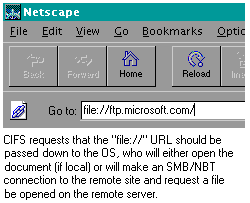
For example, CIFS has been published as an informational Internet draft. This means that Microsoft can tout CIFS as an Internet "standard," because it has been documented with the Internet Engineering Task Force (IETF). However, its "informational" status also means that it is a read-only document, and is not part of an IETF working group. This means that Microsoft owns and operates the "standard" as they see fit, and may incorporate dependencies on other Microsoft products without fear of retribution or denial of acceptance. This makes its success as a widely-adopted standard seem somewhat unlikely. Novell and SunSoft just aren't going to back a technology that they have no control of.
To be fair, SunSoft has played this same game in the past. They have also published their NFS v2 and v3 specifications as informational, thereby keeping the future of their technology close to themselves. SunSoft claims that the NFS standards were published for the benefit of the millions of systems that used it (an argument that Microsoft also uses). This may be true, but there were also dozens of vendors that cried out over the fees spent on licensing the technology from SunSoft. Microsoft and Novell, who do not wish to see their technologies kept out of the Internet market, are not going to promote the filling of Sun's coffers at their expense.
Novell, who has yet to publish anything with the IETF regarding NCPs, seems to be a dark horse in this race. Considering that they have a superior technology and the largest market share, they could easily dominate the market by submitting their technology to an IETF working group, who would then convert NCPs into an open, accessible standard. Novell is unlikely to do this, to say the least.
There's another option, however. Prior to publishing CIFS, Microsoft and their development partners had originally turned the SMB protocol specifications over to the X/Open group for licensing and administration. X/Open could possibly submit their work to the IETF for review as a working group standard. There would have to be a lot of work done to the SMB specifications prior to it being accepted, like making it work explicitly over TCP/IP instead of relying on NetBIOS naming. Additionally, the SMB specifications would have to be consolidated with CIFS, which departs from the SMB v2 specification considerably. SunSoft and Novell might back this effort since it would be open to their influence, and would also remove Microsoft as the control point. Whether or not any of this will come to pass remains to be seen.
Distribution Dictates Success
If there were four different and incompatible versions of HTTP, the Web would have never been adopted as rapidly as it has. The same is true of all the successful standards, from SMTP mail to DNS. The driving factor behind the rapid success of these services has been a unified effort backed by a variety of vendors, none of whom had a financial stake in the adoption of their technology. Without a similar multi-vendor unified standard, it seems unlikely that a widely-supported network filesystems protocol will emerge.
If the open standards process fails, then the market will tend towards the de-facto standards, a fact which is not lost on these vendors. The winning technology - if it turns out to be one of these - will likely be based on the one that is the most accessible to the widest number of users.
For example, every copy of NT 4 that Microsoft sells will further their position as the de-facto standard on the desktop. And since CIFS is supported as an operating system service, all applications will work with it immediately, which certainly plays to their advantage. But one of the most important aspects of the Internet's success is it's lack of dependence on any specific operating system or application. Since Microsoft hasn't seriously backed any technology on any non-Microsoft OS, its complete adoption seems extremely unlikely in any immediate time frame.
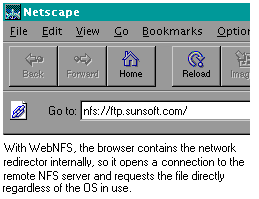
SunSoft realizes that Microsoft has the advantage in being able to support CIFS technology directly in their OS, and is suggesting that vendors embed WebNFS in their products directly, thereby making Microsoft's advantage irrelevant. Rather than attempt to get WebNFS installed on all of the PCs in existence, SunSoft is pushing to have WebNFS embedded directly into browsers. Among the vendors backing this effort is Netscape, who will be embedding WebNFS directly into Navigator. When a user clicks on a NFS:// URL, Navigator will make the NFS connection directly, avoiding the underlying OS' network technologies completely.
Since Netscape dominates the browser market on multiple platforms, this seems to lend credence to the possibility of WebNFS succeeding as the de-facto standard, at least in the short term. As Netscape ports their products and technologies to new platforms - and as they further convert Navigator into a self-contained platform in its own right - this lead will widen. But will it maintain momentum over adoption of NT v4.0 as a corporate platform? And what does the future hold for NCPs-over-TCP/IP? There's no clear victor yet, and there isn't likely to be one for the next three or four years. Until the vendors learn to develop a truly cooperative, working group-driven standard, no one will win.

Copyright © 2010-2017 Eric A. Hall.
Portions copyright © 1996 CMP Media, Inc. Used with permission.